Kegels vs Reverse Kegels for Men: Which Do You Need?

Kegels and reverse kegels train the same muscles in opposite directions. A kegel contracts and lifts the pelvic floor. A reverse kegel releases and lengthens it.
Men need both for real pelvic floor control, though rarely in equal measure. The right emphasis depends on what is holding you back: weakness, poor timing, or an inability to let go.
A floor that squeezes hard but cannot let go is tense, not trained. A tense floor loses control as surely as a weak one.
Reverse kegels for men close the gap that strength-only programmes leave open. They train the floor to release on demand.
Control means moving both ways: tighten when you need to, let go when you need to, then settle back to neutral on its own.
This guide covers the difference between the two exercises. More usefully, it shows how to tell which one you need first.
Kegels vs reverse kegels: the short answer
Kegels contract and lift the male pelvic floor. Reverse kegels release and lengthen the same system. The kegel vs reverse kegel difference is direction, not a different set of muscles. Same structures, moved opposite ways.
A floor trained only to squeeze is like a hand that can only clench. Fine for some things, useless in the moments that count.
Oxford University Hospitals NHS describes good pelvic floor function as three skills: tighten, hold, and fully relax. All three carry equal weight. These exercises build coordination, and coordination beats raw strength here.
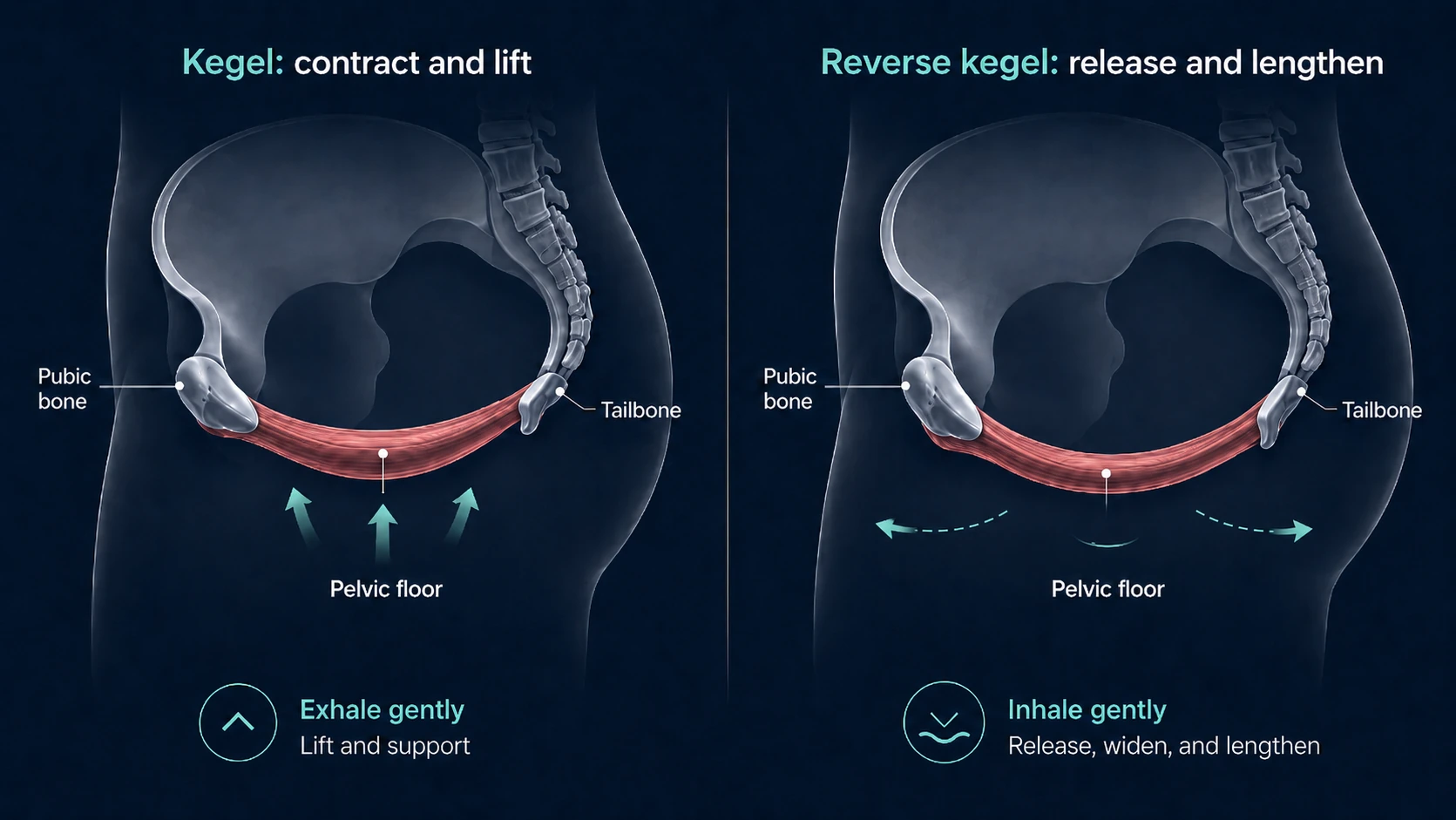
The table below sets the two side by side, including when to lean toward each.
| Exercise | Direction | Breath cue | Correct feeling | Main training value | Emphasize when |
|---|---|---|---|---|---|
| Kegel | Contract and lift | Exhale supports lift | Subtle internal squeeze and lift | Strength, timing, awareness | You can relax fully but lack contraction control |
| Reverse kegel | Release and lengthen | Inhale supports release | Softening, widening, letting go | Relaxation, tone control, return to neutral | You over-clench, brace, or cannot fully release |
What a kegel trains
A standard kegel contracts the pelvic floor upward. The main muscles are the levator ani group, plus the external urethral and anal sphincters.
Those sit along the base of the pelvis and control the flow of urine and stool.
Kegel exercises for men train the closing and lifting side of the system, the part behind urinary control and sphincter strength.
The cue is simple: contract as if stopping the flow of urine, without gripping the glutes, abdomen, or thighs. Keep it internal and subtle, and release fully between each rep.
What a reverse kegel trains
A reverse kegel releases the same muscles a kegel contracts. It is a controlled lengthening of the pelvic floor, led by a slow inhale.
As the diaphragm drops, the pelvic floor follows: it softens and widens and eases down. What you feel is a quiet opening at the base of the pelvis, closer to letting go than to doing something.
For men learning reverse kegels, that is the whole movement. It is subtle, and it should never feel like effort.
How to know which one you need
If you can contract but struggle to fully let go, reverse kegels usually come first. If you can release easily but lack strength, timing, or endurance, lead with kegels.
Whichever direction is missing is the one to train first.
Most men never have to choose permanently. Work out which side of control is weaker right now, then rebalance. The steps below help you read your own pattern.
- Start with release awareness. If you cannot feel the pelvic floor soften, emphasize reverse kegels first.
- Check what happens after a contraction. If the muscle stays tense after a kegel, add more release work before adding more holds.
- Watch for compensation. If your abs, glutes, thighs, or breath take over, reduce intensity and rebuild control.
- Use symptoms to choose your next step, not to diagnose yourself. Persistent pain, urinary difficulty, or worsening symptoms should route to assessment.
- Train both once the missing direction is clear. The long-term goal is not only strength or only relaxation, but controlled movement between the two.
When to emphasize reverse kegels
Some men do better leading with release. The pattern is easy to spot.
It shows up as kegel training that stalled or made things worse, urinary urgency without leakage, trouble starting urination, or tension that climbs with stress and never fully lets go.
For these men, more contraction work usually deepens the problem. Build the release side first, and the system gets room to work.
If too many kegels seem to have made things worse, that is its own pattern worth understanding, covered in Hypertonic Pelvic Floor in Men: Why Kegels Can Backfire.
When to emphasize kegels
Standard kegel training fits men with a genuinely underactive floor: low resting tone, weak contractions, little endurance. Progressive contraction work is the right emphasis for them.
If you can already release the floor fully and settle to neutral without effort, but cannot hold a contraction when you want one, kegels are the missing direction.
When to get assessed instead of guessing
Persistent pain in the perineum, tailbone, groin, or testicles with no clear cause is not something to train through. It warrants professional assessment. So do worsening urinary symptoms, real difficulty starting urination, or pain during ejaculation.
A pelvic health physiotherapist can read tone, coordination, and function in ways no self-directed programme can match. Getting assessed is the most efficient place to start, not an obstacle to training.
Why reverse kegels are not pushing
A reverse kegel is a gentle release, not a downward push. Bear down, hold your breath, or build pressure, and you have left release behind for strain.
The most common error in reverse kegel technique is treating release as a downward push.
Bearing down hard, especially while holding the breath, creates a Valsalva maneuver: a closed-airway, high-pressure strain that significantly increases intra-abdominal pressure. Controlled release does the opposite.
Pelvic floor relaxation works through breath, not force. The floor never pushes down. It softens and lowers as the inhale opens space for it to move.
NHS clinical guidance describes the right sensation as a quiet, gradual settling toward resting position. No push. No effort.
Ignore any cue that tells you to force urine or stool out. That instruction produces bearing-down, and it is exactly where many men go wrong.
If the movement feels like work, you have drifted into straining. Correct release is quiet. It should feel like softening, nothing more.
How breathing changes the movement
The diaphragm and the pelvic floor move together. Inhale, and the diaphragm drops while the pelvic floor widens and lowers.
Exhale, and the diaphragm rises while the pelvic floor lifts. The breath guides the movement rather than replacing the exercise.
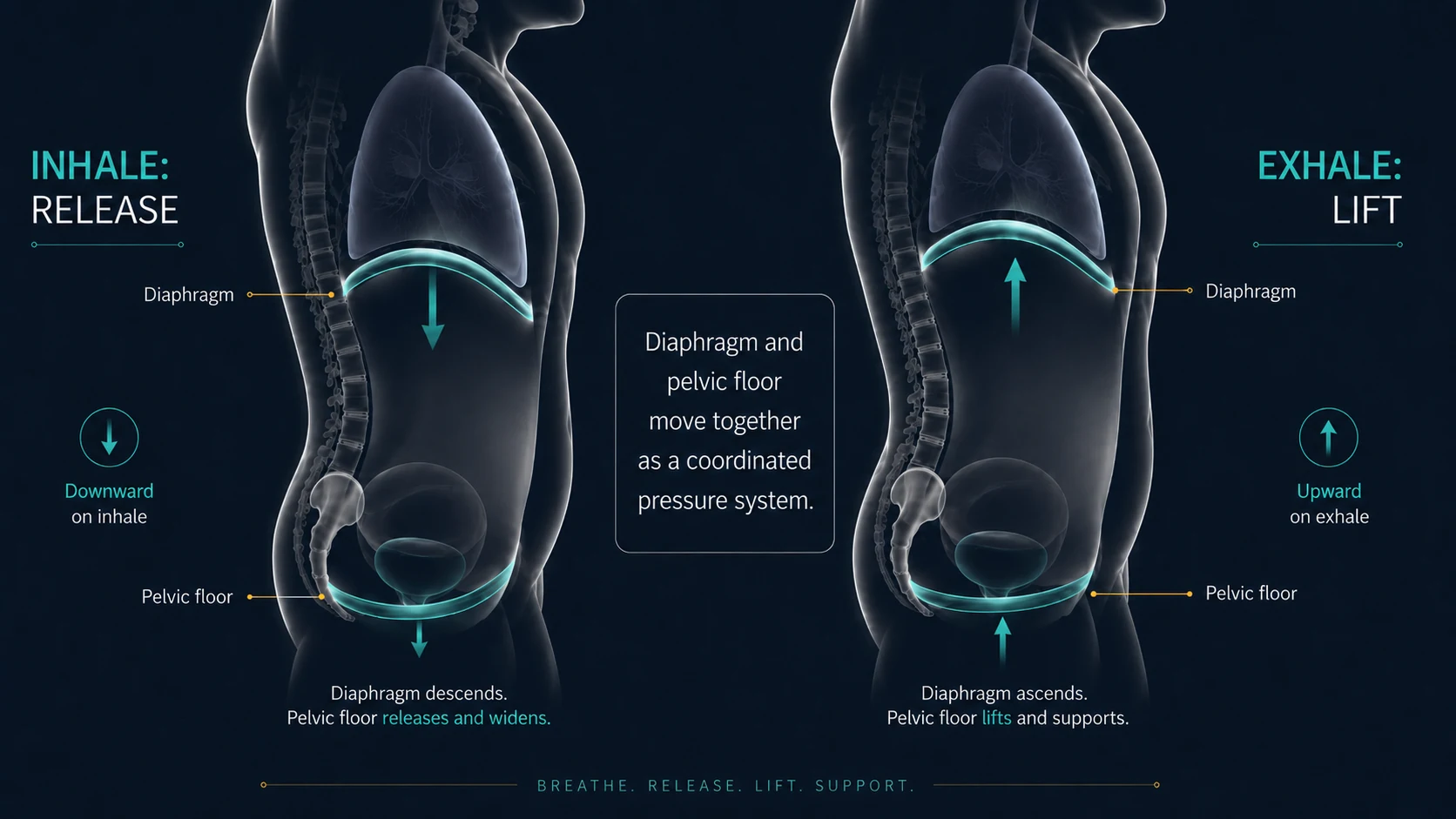
This link is built into the body, not a coaching trick. A slow, full inhale does more than help the floor release. It gives the release its starting signal.
A steady exhale supports the lift of a kegel. Pair each exercise with its natural breath, and both get easier to feel and more accurate.
Diaphragmatic breathing, the kind that expands the belly and lower ribs in every direction instead of just the chest, is the skill to build first.
Without it, the floor gets a weaker signal to respond to, and the movement is harder to find.
Inhale supports release
On a slow inhale, the diaphragm drops and pressure in the abdomen rises. The pelvic floor answers by widening and lowering.
That makes the inhale the natural entry point for a reverse kegel. Let the breath create the descent instead of pushing the floor down.
Exhale supports lift
On a steady exhale, the diaphragm rises and the pelvic floor lightens with it. That makes the exhale the entry point for a kegel contraction. The lift rides the exhale rather than fighting it.
Inhale to release. Exhale to lift.
- Inhale slowly.
- Let the lower ribs and abdomen expand.
- Allow the pelvic floor to soften.
- Exhale steadily.
- Let the pelvic floor lift lightly.
- Return to neutral before repeating.
Why relaxation matters as much as contraction
A pelvic floor that can contract but cannot release is tight, not controlled. Real control needs two things: enough strength to lift, and enough range to come back to neutral.
Resting tone is where the muscles sit between demands, their idle setting. Set it too high and range narrows, so precision drops. Relaxation carries the same weight as contraction here. Coordination needs both directions, in balance.
Tight does not mean strong
High tone restricts the muscle rather than powering it. A floor starting from a chronically shortened position has less capacity to generate force and less ability to release when needed.
The Cleveland Clinic describes a hypertonic pelvic floor as one with elevated resting tone. Such a floor can be tense, poorly coordinated, easily fatigued, and functionally weak at the same time.
Tightness is not strength, and treating it as strength is where a lot of men go wrong.
More kegels are not always the answer
Standard kegel training works well for a genuinely underactive floor. Add contractions to an already-overactive one, though, and function gets worse, because you are piling load onto restriction.
Royal Berkshire NHS is explicit: strengthening is less effective when the muscles are already tense. Release has to come first.
That is why reverse kegels deserve a place in most balanced programmes, not only in ones built for high tone.
For the full picture of why kegels can backfire on a tight floor, see Hypertonic Pelvic Floor in Men: Why Kegels Can Backfire.
The male pelvic floor muscles involved
The male pelvic floor is a layered system, not a single muscle, and every contraction or release trains it.
The levator ani forms a hammock across the base of the pelvis and holds up the organs above it. Inside it sit the pubococcygeus and the sphincter muscles that control urine and stool.
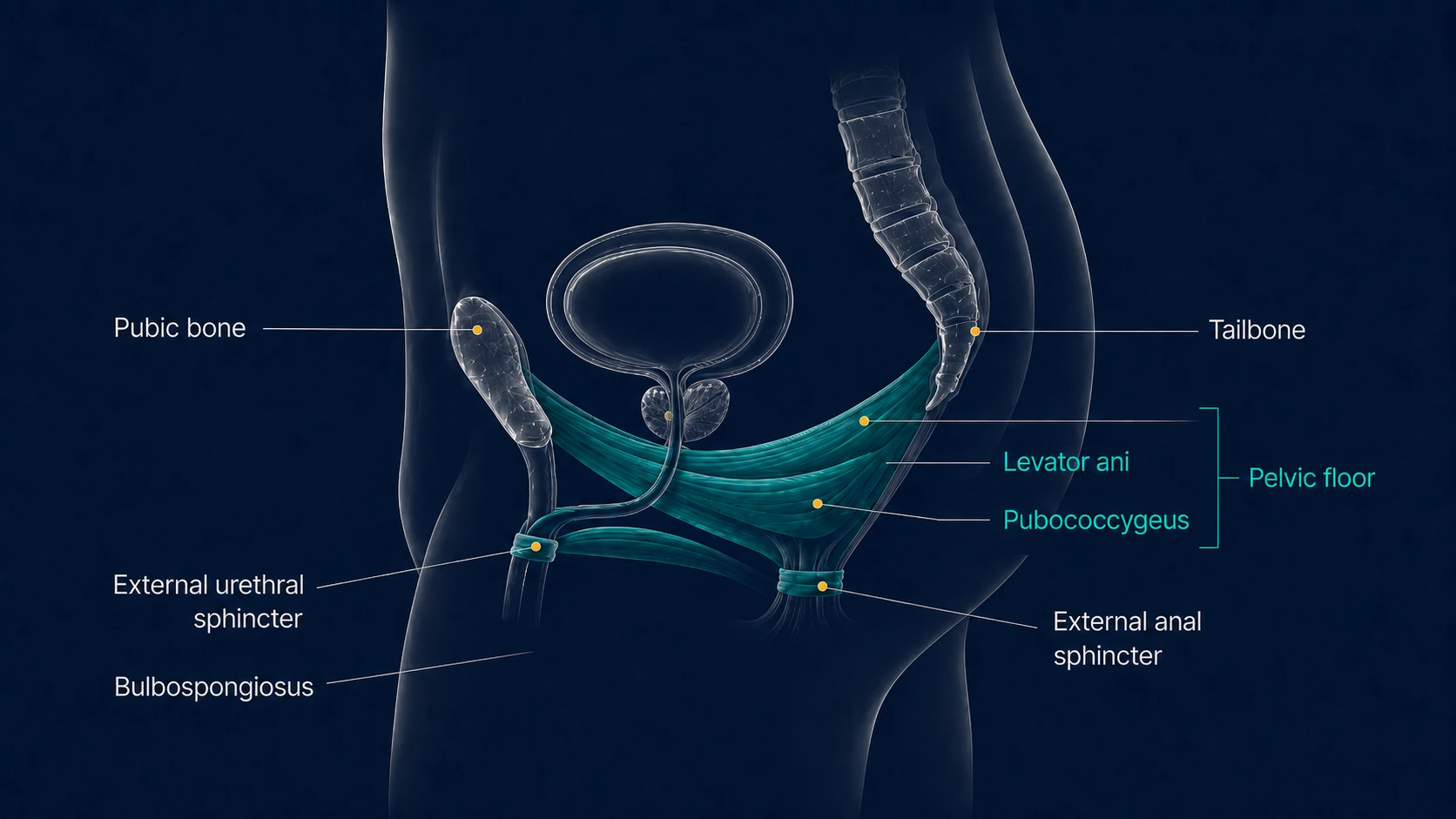
Kegels and reverse kegels train different directions within this same system. You do not need the anatomy memorised.
The thing to hold onto is simple: one structure both contracts and releases, and training only one direction leaves the other underbuilt.
Why the bulbospongiosus matters for coordination
One outer-layer muscle is worth naming: the bulbospongiosus. It contracts rhythmically during ejaculation to move fluid through the urethra.
It comes up again and again in research on pelvic floor rehabilitation in men.
Training both its contraction and its conscious release is more targeted than a general kegel. You are teaching one muscle to work both ways instead of only one.
How to combine kegels and reverse kegels in one session
Most men can train both in one session: release first, contraction second, a final release to close. Loading a muscle that is ready to relax beats loading one that is already braced.
A simple session structure
A good session runs both exercises in sequence, release before contraction. Treat the structure below as a starting point, not a fixed prescription, and set the holds to your current capacity.
- Awareness breathing. 1 to 2 minutes of relaxed diaphragmatic breathing.
- Release sets. 5 slow breaths, each paired with a deliberate pelvic floor release on the inhale. Soften gently, then let it return.
- Contrast sets. 5 rounds: release on the inhale, hold on the exhale.
- Hold sets. Timed contractions at your current capacity, for example five seconds in each direction, with the breath moving throughout.
- Closing release. 5 slow breaths, each with a gentle softening.
Why the closing release matters
After kegel holds, the floor can stay half-contracted, and that residue builds up across sessions if you leave it. The closing release brings it back to resting tone before you stop.
Five slow breaths, each paired with a conscious softening, is usually enough. That is how the floor keeps the range that makes the next contraction worth doing.
Common mistakes men make with reverse kegels
Most reverse kegel errors fall into the same handful of patterns. Catch them early and you save time and skip a lot of needless strain.
- Bearing down. Straining forcefully downward is a Valsalva maneuver, not a reverse kegel. If it feels like effort, stop.
- Holding the breath. Breath-holding creates bracing and elevated abdominal pressure, the opposite of release. Keep the breath moving throughout.
- Tensing the glutes, abdomen, or thighs. Visible or felt movement in these areas means compensation. The work stays internal.
- Chasing a strong sensation. Correct release is quiet. If it does not feel like much, that is often correct.
- Dropping contraction work without understanding why. Learning that your floor may be tight does not mean kegels stop. Both directions stay relevant for most men; the ratio is what changes.
- Practising in high-demand moments before the skill is established. Isolated practice comes first.
What research can and cannot say
The research is useful, but it is not as complete as most articles make it sound. Most studies are small, supervised, and device-assisted.
No randomised controlled trial has directly compared kegel and reverse kegel programmes in healthy, non-clinical men. That gap is real, and worth stating plainly.
What the research does show: pelvic floor rehabilitation that combines contraction and relaxation has produced meaningful results in supervised clinical settings. The men studied had conditions including premature ejaculation and chronic pelvic pain.
The benefit comes from training the full range of the floor, not from contraction alone.
The honest takeaway is straightforward. Research backs both contraction and relaxation as parts of an effective pelvic floor programme.
That evidence comes from supervised clinical settings, not self-directed home training. Applying it at home is reasonable, but current trials do not directly prove it.
For men without symptoms, the case for training both directions rests on anatomy and physiology. For men with symptoms, a professional assessment comes before any training programme.
Where this article cites named sources, it does so to describe mechanism and observation. Research suggests benefit. It does not guarantee one, and it sets no fixed timeline.
FAQ
How do I know if I'm doing a reverse kegel correctly?
A correct reverse kegel feels like a quiet softening at the base of the pelvis, not like effort. On a slow inhale, the floor widens and eases down as the breath makes space for it. No straining, no downward push. If your abdomen, glutes, or thighs kick in, or you are holding your breath, the movement has slipped toward bracing. The sensation stays subtle. Many men expect something dramatic and assume they are doing it wrong when they feel very little. In reverse kegels, feeling little is often the sign you are doing it right.
Can I do both kegels and reverse kegels in one session?
Yes, and most men benefit from doing exactly that. Put release first, contraction second, and a final release at the end. Starting with reverse kegels prepares the floor to relax before you load it with holds. Finishing with release returns the floor to resting tone, so the session does not end on residual tension. The closing release matters as much as the contractions. It preserves the range that makes the next session effective.
Is a reverse kegel just deep breathing, or done with breathing?
It is done with breathing, though it is not the same as breathing. A slow inhale starts the release, but the reverse kegel is a deliberate softening of the pelvic floor that the breath guides. Diaphragmatic breathing is the prerequisite skill, because the diaphragm and pelvic floor move together. Without it, the floor gets a weaker signal to respond to. The breath is the engine, and the conscious release is the movement. One supports the other.
Can reverse kegels make things worse if I push too hard?
Yes. The most common way to get a reverse kegel wrong is to bear down forcefully, often while holding the breath. That is a Valsalva maneuver, a high-pressure strain, and it is the opposite of release. A reverse kegel is a gentle, breath-led softening, never a downward force. If it feels like work, stop and reset with a few relaxed breaths. Any cue telling you to force urine or stool out is the wrong cue for this movement.
How do I tell if I'm over-clenching?
Signs of over-clenching include a floor that stays tense after a contraction, trouble feeling any softening on the inhale, and tension that builds with stress and never fully lets go. Some men notice urinary urgency without leakage, or difficulty starting urination. If you cannot feel the floor relax at all, or more kegels seem to make things worse, that points toward a high-tone pattern. The pattern and what to do about it are covered in Hypertonic Pelvic Floor in Men: Why Kegels Can Backfire.
Should I use reverse kegels during sex, or only in training?
Build the skill in isolated practice first. Trying to apply release in a high-demand moment, before you can do it calmly, tends to backfire. Once the movement is reliable on its own, some men start applying it elsewhere. Applying pelvic floor control to timing and arousal is its own subject, covered in our dedicated stamina guide on pelvic floor and ejaculation control. This article is about the difference between the two exercises and how to train them, not about in-the-moment application.
Bottom line: train both directions, emphasize the right one first
Kegels build the strength and timing the pelvic floor needs. Reverse kegels create the range that gives that strength somewhere to go. Real control lives in both directions at once.
Reverse kegels for men are the other half of the same skill, not a fix for weak kegels. Contraction without release trains one end of the range. Coordination needs both ends.
Most men never have to choose permanently between kegels and reverse kegels. Find the missing direction first, train it, then keep both in balance.