Erection exercises: how pelvic floor training supports erectile rigidity
Erection exercises that train the pelvic floor work on one part of an erection: how hard it gets and how well it holds. The short version: rigidity is a pressure and outflow story.
For erections, what matters is less where the pelvic floor sits than what it can do at the base of the penis. Its job there is to add pressure once blood is already in.
Train it well and you are working on firmness and pressure control once inflow has done its part. What these exercises do not do is create the first rush of blood that begins an erection.
That surge runs on nerves and smooth muscle. No amount of squeezing switches it on.
How pelvic floor conditioning affects penile blood flow and rigidity
If you have heard that erection exercises simply increase blood flow, that is too vague. Blood flow starts the erection. The pelvic floor matters more for what happens next: pressure, firmness, and keeping blood from draining out too quickly.
Part of the confusion is that blood flow sounds like the whole answer. It is not. An erection is a sequence, and different parts of it fail for different reasons.
Pelvic floor conditioning affects penile blood flow only indirectly. Its real contribution is erectile rigidity: raising the pressure inside the penis and slowing the drainage of blood back out. This works after inflow, not before.
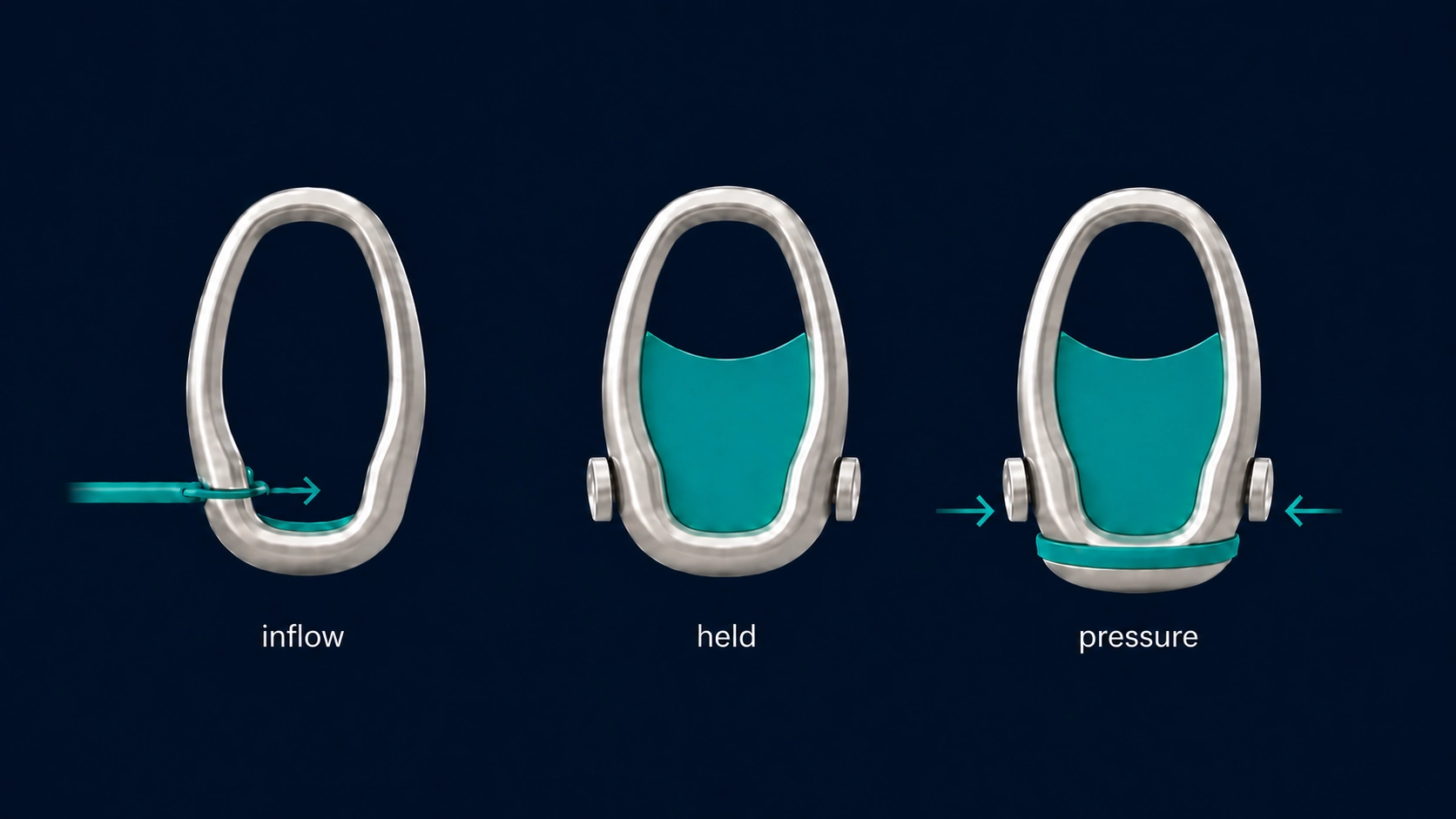
Picture two jobs: getting blood in, then keeping it in under pressure. Inflow does the first; the pelvic floor reinforces the second.
Arterial inflow starts the erection
The opening move is not muscular. Nerve signals trigger nitric oxide, a chemical messenger, which relaxes the smooth muscle in the penile arteries and erectile chambers. That relaxation lets blood rush in.
This is what "blood flow" really refers to, and it runs on nerves, the vessel lining and smooth muscle. Your pelvic floor does not command it. So the claim that erection exercises increase blood flow points at the wrong stage.
Pressure and venous-outflow control help maintain rigidity
This is where training earns its place. Once blood is in, staying firm is a pressure problem, and the pelvic floor is built to add pressure.
As the erectile chambers fill, they squeeze the drainage veins shut, restricting venous outflow, the escape of blood back out. Two muscles reinforce that seal.
The ischiocavernosus (ICM) is a paired muscle wrapped around the roots of the erectile chambers. When it clamps down, it drives intracavernosal pressure, the pressure inside the chambers, above the pressure in the arteries feeding them. In testing, voluntary contractions have pushed it far above arterial pressure (Lavoisier 1986).
The bulbospongiosus (BSM), which wraps the base and the tissue around the urethra, may add to firmness too, though its erectile role is genuinely debated. The pressure and outflow effect is the real handle training has on an erection.
Why this is different from a simple blood-flow claim
"More blood flow" misplaces the mechanism. The inflow that begins an erection is a nerve-and-smooth-muscle event, outside what training reaches.
What conditioning genuinely changes is the pressure and outflow side: lifting internal pressure and keeping the drainage veins shut a little longer. That is a real, defensible target, and it is the honest promise behind erection exercises.
One trial in men with diabetes and medicated erectile difficulty did record a blood-flow change after training. That is a narrow result in a specific group, not a blanket claim that training raises blood flow for everyone.
| Phase | Main driver | Pelvic floor role | What you can safely say |
|---|---|---|---|
| Start of erection | Arterial inflow and smooth-muscle relaxation | Indirect or limited | Not driven by pelvic floor training. |
| Maintenance | Veno-occlusion | Supports pressure and restricts outflow | This is the pressure-and-outflow side conditioning can support. |
| Rigid phase | Ischiocavernosus and bulbospongiosus contraction | Raises pressure inside the penis | Strongest reason to train the pelvic floor for erections. |
Which pelvic floor muscles matter for erection quality?
Three muscles do the erection-relevant work, and they are not equal partners. The ischiocavernosus drives rigidity. Around it, the bulbospongiosus adds a debated contribution and the levator ani holds the base steady. If you are training pelvic floor exercises for men with erections in mind, the ischiocavernosus is the one to understand first.
Ischiocavernosus: the clearest rigidity role
Start with the ischiocavernosus, because it has the clearest link to hardness. It is a paired muscle wrapped around the roots of the erectile chambers. When it contracts, it squeezes those roots and drives intracavernosal pressure above the pressure in the arteries feeding them.
That is what takes an erection from full to rigid. In practice, this is the muscle behind the last bit of firmness, the difference between swollen and hard. It fires mostly as a reflex, and late in the sequence, which is one reason voluntary training only goes so far.
Bulbospongiosus: relevant, but not the whole story
The bulbospongiosus is where the picture gets contested. It wraps the base of the penis and the spongy tissue around the urethra, helps engorge that tissue and the head, and powers the muscular contractions of ejaculation.
Whether it adds much to erectile rigidity is genuinely debated. One influential study labelled it the muscle of ejaculation and the ischiocavernosus the muscle of erection (Shafik 1995). So treat any source that calls it the muscle that pumps blood into the penis with caution. Its clearest job is ejaculatory, and the rigidity case rests mainly on the ischiocavernosus.
Levator ani: support, tone and coordination
The levator ani is the broad sling underneath, and it supports rather than drives. It does not clamp the penis directly. What it gives is a stable base, steady baseline tone, and the endurance the other two muscles work against. Think of it as the floor the pressure-generating muscles push off from. Training it supports coordination and control, not rigidity on its own.
Kegels vs reverse kegels for erections
The short version: kegels train the squeeze, reverse kegels train the release, and a good program often needs both. Kegels build the contraction and pressure that stiffen an erection. Reverse kegels restore the muscles' ability to let go, which matters more than it first sounds. Which one you emphasise depends on whether your floor is underworked or too tight.
What kegels train
Kegel exercises for men are, at their core, a contraction. You draw the pelvic floor up and in, hold briefly, then release. Done for erections, the aim is to train the ischiocavernosus and its neighbours to generate pressure on demand. For you, that is the firmness side: better control of the final squeeze that holds an erection rigid.
Two contraction styles cover the range. Longer holds build the endurance to maintain pressure. Quick contractions target the fast, reflexive firing of the rigid phase, though the erection-specific evidence for them is thinner. This is the training category behind most exercises for stronger erections. Keep the reps controlled, because the goal is clean isolation, not maximum force.
What reverse kegels train
A reverse kegel is the opposite move: a deliberate lengthening and release instead of a squeeze. You let the pelvic floor drop and open, usually on a slow exhale. This trains release capacity, and release is not optional. The veno-occlusion that holds an erection depends on the surrounding smooth muscle staying relaxed, so a floor that cannot let go works against you.
In practice, reverse kegels for men protect the relaxed base that firmness is built on. The full how-to, including breathing and positioning, lives in the reverse kegel guide. Here the point is narrower: contraction and release carry equal weight. Release is not a cool-down afterthought.
Why stronger is not always better
More squeezing is not always the answer, and sometimes it is the problem. A pelvic floor can become too tight, or hypertonic, meaning it holds tension it cannot fully release. A tight floor can compress the pudendal artery and limit inflow, and it undercuts the relaxation that veno-occlusion needs.
Piling on kegels can then make a too-tight floor worse. The sign to watch is a floor that feels clenched or never quite relaxed, alongside erection trouble. If that fits you, the move is down-training and release before any strengthening. The too-tight case is covered in depth in a separate guide.
| Exercise type | Main action | Best fit | Main caution |
|---|---|---|---|
| Kegels | Contract and lift | Weak or poorly coordinated floor | Overdoing them can worsen tightness. |
| Reverse kegels | Relax and lengthen | Overactive or poorly releasing floor | Not a standalone cure. |
| Balanced training | Contract, release and coordinate | General vitality-focused conditioning | Technique matters more than intensity. |
What the research shows about pelvic floor training and erectile function
The pressure mechanism is well supported. The treatment evidence is promising but still limited. Small studies suggest pelvic floor training helps a meaningful share of selected men with erectile difficulty. What they do not show is that unsupervised kegels at home match those results. The good outcomes mostly came from supervised programs with biofeedback.
The strongest clinical signal
The clearest signal comes from two studies. A 2004 randomised trial put 55 men with erectile difficulty through a supervised program of pelvic floor exercises, biofeedback (real-time feedback on the muscle) and lifestyle change (Dorey 2004). At six months, about 40% had regained normal function and roughly another third had improved.
A later systematic review found that pelvic floor training appears to help erectile function (Myers and Smith 2019). Across studies, a third to a half of men reached normal function. Two things temper that. The Dorey program bundled exercises with biofeedback and lifestyle change, so the exercise effect cannot be cleanly separated. And the review found no single best protocol.
Why the evidence needs careful wording
This is why the wording matters. The trials are small, often single-centre, and many added biofeedback or electrical stimulation on top of the exercises. That makes it hard to say how much the exercises did alone.
Some sources call pelvic floor training proven or first-line. The trial authors did use first-line, but that was their read of one small study, not a settled fact.
The narrow blood-flow finding
One recent trial is worth naming precisely, because it is easy to misuse. In 2026, researchers tested pelvic floor training in 90 men with type 2 diabetes and a vascular cause of erectile difficulty, all taking sildenafil (Ahmad 2026). Training improved a measure of penile blood flow and erection scores, and low-intensity shockwave therapy did slightly better.
That is the one credible blood-flow result, and it sits in a narrow group: diabetic, medicated, with a vascular cause. It does not license a general claim that erection exercises raise blood flow for everyone.
Mechanism support, not treatment proof
Animal work, including a 2024 baboon study, supports the pressure model but does not prove training outcomes in men. Treat it as mechanism support, not a promise.
How long before pelvic floor training may affect erections?
Realistically, weeks to months. Anyone promising a hard number is guessing. The trials that showed benefit assessed men at three and six months, not at a tidy four-week mark. The one short study, at six weeks, was the narrow diabetic and medicated group above, not the general case.
Two things shape your own timeline. One is your starting point: a weak, poorly coordinated floor may respond differently than a tight one that first needs release. The other is consistency. Pelvic floor muscle is still muscle, and it changes with regular, correct training over weeks, not with one hard week of effort.
The useful frame is patience with a routine you can keep, not a countdown to a deadline. If you have trained consistently for a few months with no change at all, that is a signal to rethink the approach, not to squeeze harder. Skip the fixed-calendar promises you will see elsewhere. Individual variation here is large, and a fixed date only sets you up to quit early or push too hard.
When pelvic floor training is worth considering and when to get assessed
Pelvic floor training for erections makes the most sense when the problem is muscular, not arterial or hormonal. A quick way to place yourself:
- Trouble getting an erection at all: training is probably not the main lever.
- Getting firm but not staying firm: the pressure and outflow side may be relevant.
- A floor that feels clenched, painful or hard to release: down-training and release come first.
- New, worsening, or not improving after a few months: get assessed.
Erectile difficulty has many causes, including vascular, hormonal, neurological and medication-related ones. Training addresses only the muscular slice. For many men a careful, balanced routine is a low-risk trial; for a tight or painful floor, release work comes first.
Signs the muscular component may be relevant
The muscular angle is most plausible when getting an erection is not the issue, but holding it is. If you can get firm yet lose it sooner than you would like, the pressure-and-outflow system is a fair suspect. Some men also notice an erection softening when they stand up. That can point toward the veno-occlusive side, where the pelvic floor plays a supporting part. None of this is a diagnosis. It is a way to judge whether training is even worth a few months of your time.
Signs this is not just a training issue
Some signs mean training is not the first move. New erectile difficulty, or a clear change from your normal, deserves a medical look before anything else. The same goes for trouble that keeps getting worse, or that persists despite sensible effort.
This matters beyond erections. New erectile difficulty can be an early sign of heart or blood-vessel disease, so it is worth taking seriously rather than training around. This article is educational and is not medical advice. If something feels off or is not improving, get it assessed.
The too-tight pelvic floor case
Some men have the opposite problem: a floor that is already too tight and cannot fully relax. Loading that with more kegels tends to make things worse. The route here is down-training, breathing and reverse kegels to restore release, usually best guided by a pelvic floor physiotherapist. See the dedicated guide for the too-tight case.
A practical way to think about erection exercises
A good erection-focused routine should train three things: finding the right muscles, producing a clean squeeze, and fully releasing afterward. It also means avoiding the habits that stall progress. These are principles, not a medical protocol. Sets and reps matter less than doing the basics well and doing them consistently.
- Isolate the right muscles. The cue is a gentle lift or draw-in at the base of the penis, felt at the perineum, not the glutes or abdomen. A one-time stop-the-urine test can help you locate them. Use it once for identification, never as a routine drill.
- Train controlled contraction. Once you can find them, work the squeeze. Longer holds build the endurance to maintain pressure. Quick contractions train the fast, reflexive firing behind the rigid phase. Keep it controlled, because clean isolation beats maximum force.
- Train full release. The release is half the job. After each contraction, let the floor fully drop and lengthen, ideally on a slow exhale. This is the capacity veno-occlusion depends on, and where pelvic floor exercises for men most often go wrong.
- Avoid the common mistakes. Holding your breath or bearing down raises abdominal pressure, not floor strength. Recruiting the glutes or thighs pulls load off the target muscles. Overtraining, training through pain and racing a fixed calendar all backfire.
FAQ
Should I do kegels or reverse kegels for erections?
Often both. Kegels train the contraction and pressure that stiffen an erection. Reverse kegels train the release that veno-occlusion depends on. The right emphasis depends on your floor. A weak or poorly coordinated one leans toward strengthening; a tight, overactive one needs release first. The full technique is in the reverse kegel guide.
How long until pelvic floor training affects erections?
Weeks to months, not days, and no honest source will give you a fixed date. See the section above on how long training may take for why the real answer is a range, not a deadline.
Can pelvic floor exercises help bring back morning erections?
Do not count on it. Morning and nighttime erections are driven by automatic nerve and vascular activity during sleep, not mainly by the pelvic floor. If your overall rigidity improves, a morning erection may feel firmer. That is not the same as bringing them back. Their loss more often points to vascular, hormonal or neurological factors.
Is my pelvic floor weak if my erection softens when I stand up?
Not necessarily, and this is not one to self-diagnose. Softening when you stand is classically linked to venous outflow trouble, where blood drains faster than it should. The pelvic floor can contribute to that, so a muscular angle is plausible. Still, positional softening is a reason to get assessed, not proof that your floor is weak.
What if my pelvic floor is too tight, not too weak?
Then more kegels are likely the wrong starting point. A too-tight, or hypertonic, floor cannot fully relax, which works against the release an erection needs. The route is down-training, breathing and reverse kegels to restore that release, ideally with a pelvic floor physiotherapist. The too-tight case is covered in more depth separately.
Is there research showing pelvic floor exercises help with erectile problems?
Yes, but keep it in proportion. Small, mostly supervised studies suggest pelvic floor training improves erectile function in a meaningful share of selected men. The results are encouraging enough to justify a careful, balanced training trial. They are not proof of a cure, and the strongest programs used biofeedback and supervision, not solo home routines.
The bottom line
Rigidity is a pressure and outflow story. Blood flow starts an erection; the pelvic floor helps hold and stiffen it by raising internal pressure and slowing the drain. That is a real target, and for many men a careful, balanced routine is worth a fair try. It is not a cure, and results build over months, not days. Train the basics, and give it time.